

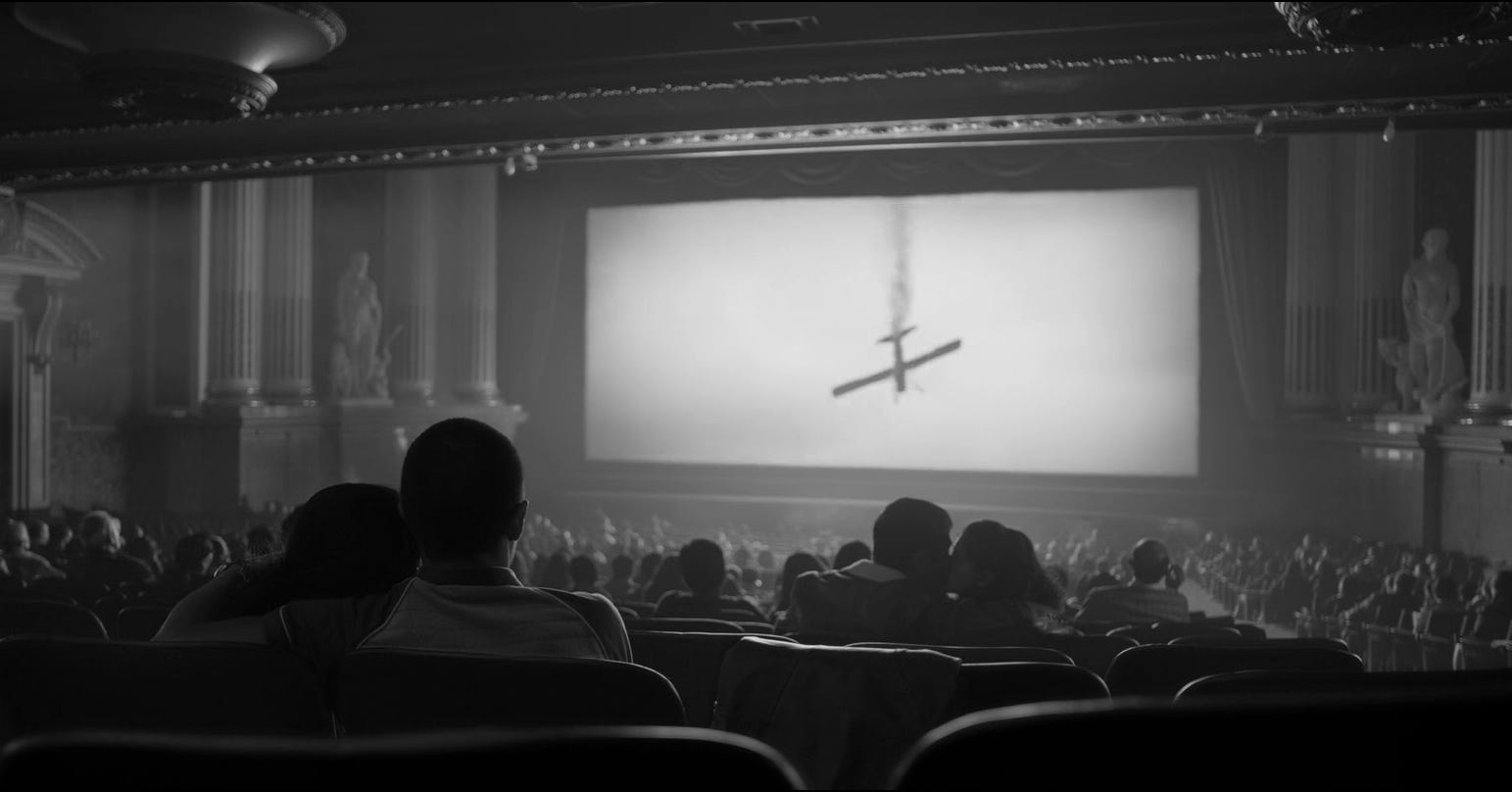
What exactly is so special about going to the movies? The usual answer is it’s about sitting in the dark with a bunch of strangers and having a shared experience that demands your undivided attention. But you don’t need a movie for that — you can just as easily get it from live music, or theater, or a standup show. The other standard argument is about scale and sensation: a film should be seen on the biggest possible screen with the best possible sound. But it’s now within the means of many to approximate the multiplex on home systems that fill as much of your field of view and deliver the same crisp spatial audio, and yet the existence of 8K TVs and Dolby Atmos speakers doesn’t seem to console anyone fretting about the death of movie theaters. Communion and immersion are both clearly essential to the filmgoing experience. But if they’re not the things that make it unique, then what is?
Consider every other type of real-world collective experience: concerts, plays, musicals, sporting events, religious services, lectures, parades, fireworks displays, and anything else where viewers or listeners gather in a physical place. All of these involve some form of live performance. The specific thing you witness on a particular night in an opera house or a hockey arena will never occur in that precise way ever again. It can be repeated, but it can’t be replicated. A live performance only happens once.
Movies are different. For the first time in the long history of communal entertainment, we found a way to capture a living performance and make it perfectly reproducible. The motion picture gave us an entirely new kind of spectacle: a performed work that could be exactly the same to everyone at all times, needing only a projector and a screen to be delivered to any crowd, anywhere, for nothing more than the cost of the print and the electricity to run the bulb.
In his 1935 essay “The Work of Art in the Age of Mechanical Reproduction,” Walter Benjamin tried to make sense of this strange new situation. He used the term “aura” to describe what falls away from an artwork when it can be easily reproduced. At one end of the aura scale are ceremonial objects used in religious rituals. These items can’t be copied and often aren’t even meant to be seen by the public. The emphasis is on their “cult value.” At the other end of the spectrum are works that can be duplicated and distributed everywhere. What matters most is their “exhibition value.” Film, Benjamin believed, was the ultimate destroyer of aura. A powerful new medium completely detached from ritual and tradition, capable of reaching the masses in ways no art form ever had.
Benjamin had been struck by a prediction made by the French poet Paul Valéry in a 1928 piece called “The Conquest of Ubiquity,” which he quotes in his essay:
Just as water, gas, and electricity are brought into our houses from far off to satisfy our needs in response to a minimal effort, so we shall be supplied with visual or auditory images, which will appear and disappear at a simple movement of the hand, hardly more than a sign.
It took almost a century, but ubiquity is finally here. The world created by Netflix and its competitors would seem to be the inevitable end of the story Benjamin tells: cinematic works reproduced not just in theaters, but in our homes and in our hands, flowing everywhere on Earth, accessible at will. The modern streaming service is where aura reaches zero.
A typical movie theater of the 1930s wasn’t a particularly sacred space. Crowds were rowdy, and talking back to the screen was accepted as part of the show. Films played in continuous loops without advertised start times — people would wander in halfway into a showing and stay after the end to see what they’d missed. A trip to the movies wasn’t a special event. It was just something you did on a lazy afternoon.
Television changed what movies meant. The intrusion of the moving image into the American home threw Hollywood studios into crisis. They responded first by making movies bigger — widening the aspect ratio and spending lavishly on big-budget historical epics — and when this started to fail, they turned to desperate experimentation, greenlighting films by fresh voices who were speaking to a new generation of youth. Film needed to offer things you couldn’t find on TV, and for a brief time, those things were edge and sophistication. Then, with Star Wars, the studios stumbled on their new template: effects-driven spectacle that could draw people out of their homes with the promise of otherworldly yet comfortingly familiar escape. It was a formula that would reliably prop up the release calendar for another four decades. Now, in the streaming era, the crisis set off by television has returned. This time, films aren’t just competing with TV shows, but with smaller and more convenient versions of themselves.
From the 1920s to the 1940s, most Americans went to the movies at least once a week. After the rapid adoption of TV, attendance plummeted to just fifteen percent of its old levels, and then held remarkably steady relative to population for about sixty years, despite VHS, video games, YouTube, and every other thing that threatened at one time or another to kill the multiplex. It was COVID that would eventually deal the worst blow to filmgoing since the 1950s. As with the shift to hybrid-remote work, the pandemic revealed how new habits were possible, and, to some, preferable. Most people are going to the movies less often than before. Many have simply stopped going at all. What’s interesting is who those people are.
The narrative about cinema is that it’s losing its cultural position to newer forms of media, which isn’t wrong. But the collapse in theatrical attendance has occurred almost entirely among people over 50. Younger audiences are still engaged. 18 to 24-year-olds are buying movie tickets more frequently than any other age group. Filmgoing is being kept alive by generations whose habits and desires have been shaped by the internet. And, as happened when TV transformed our culture, the meaning of theatrical cinema is changing.
What do theaters offer, in the 2020s, that streaming can’t? Bigger screens still matter — we’re some years away from an affordable home setup that can replicate the scale and resolution of 70-millimeter projection or its digital equivalent. IMAX, once a niche format used mainly for science documentaries, has become central to the production and marketing of today’s blockbusters. Out of roughly forty thousand screens in North America, only about four hundred — one percent — are IMAX-capable. Cinemas equipped for 70mm are even rarer. Still, audiences are going out of their way to get to them: twenty percent of the box office take for Sinners and One Battle After Another came from IMAX screens alone; 70mm showings of both films were sold out for weeks.
Premium ticket prices and a longer trek to the cinema aren’t the only things audiences are choosing to put up with. The movie theater asks more of the viewer today than it ever has. It used to be that sitting through a theatrical film required no more focus than sitting on your couch and watching a movie on TV. You couldn’t pause a broadcast, your only other viewing options were whatever was playing on other channels, and you didn’t have a device in your hand connected to billions of internet users vying for your eyeballs. Smartphones and streaming drastically raise the psychological cost of leaving your house to see a film. If that’s a cost worth paying — as it seems to be, to large numbers of people — then our technology of ubiquity is having the paradoxical effect of increasing the value of the theatrical experience. It’s unique to our era that going to see a movie means giving up more than just your time and money. You have to put away a digital appendage that’s effectively a part of your brain and spend two or three hours looking at a thing you can’t control. Anything that deserves this kind of sacrifice must be important.
In the days when theatrical viewing was routine, people went to the movies because it was more or less the easiest way to see a movie. When the entirety of human entertainment is on tap inside the home, filmgoing shifts to a new position. Instead of being a casual act, it takes on the qualities of ceremony. Intentionality, collective experience, separation from ordinary time, and in the ideal, transformation. A practice rooted in tradition, requiring a pilgrimage to a special place with special rules. An activity that in Walter Benjamin’s time was the apex of mass-culture convenience has been recast into an aurafied ritual by its contrast with our newer methods of content delivery. Streaming has turned theaters into hallowed ground.
A simultaneous shift has been cinema’s transition into subculture. For people under a certain age, watching movies is no longer a given. This turns engagement with the medium into a marker of difference and identity. Unlike in the 90s, being a film lover offers entry into circles wider and more compelling than the group of nerds who hang out at the local video store. The basic functionality of a platform like Letterboxd — connecting you to people who’ve watched the movie you just watched, no matter where in the world they are — is unremarkable to anyone accustomed to online life, and fairly staggering in historical terms. The power of cinema’s mass-reproducibility used to flow only along the distribution path, from studio to viewer. Audiences all over the world could have the same experience, but they couldn’t talk to each other about it. Now they can. Every film you see makes you part of a new attentional community. Seeing it in a theater makes you a member of special status. You sat in the dark with your phone tucked away and took in the same two hundred thousand frames in the exact same order as your fellow congregants all over Earth. This is a novel and powerful part of the experience. As with so many of our present conflicts, the internet is powering both sides of the fight: it makes streaming possible, and it also transforms filmgoing into a global form of collective activity.
Will theaters survive in a near future where going to the movies becomes an infrequent ritual for the median film enjoyer and a regular habit only for the true believers? Will the film industry as a whole simply collapse without box office revenue to sustain it? The deal struck by Netflix to acquire one of the biggest and oldest traditional studios is being treated like a potential extinction event for theatrical cinema. But if the streaming giants want to create a world where TVs, laptops, and phones are the only screens where films are played — a strategy that is by no means a certainty, even for the famously theater-hostile Netflix — they won’t find it as easy as some may think.
As a business, theatrical exhibition is unique — a relatively small sector that punches far above its weight culturally. In 1995, total box office revenue in the U.S. was around $5 billion. The size of the home video market was $16 billion. Both of these were dwarfed by television, which brought in nearly $60 billion across broadcast, cable, and satellite. Even in what we now consider a pre-internet heyday of filmgoing, the chairman of a typical media conglomerate would have seen theatrical movies as a marginal and frustratingly unpredictable piece of their company’s revenue stream. They also would have understood that earning money at the box office wasn’t entirely the point. Theatrical releases gave films cultural currency that could be cashed in later from VHS rentals and TV broadcasts. A movie that had made its way through theaters was many times more valuable than one that had been made for television or gone straight to video. The expense of marketing and distributing a film was usually worth it even if the movie didn’t earn back its budget from ticket sales.
Netflix has tried its best to dismantle the old model and craft a new one. The halo effect of a theatrical release isn’t as important to them as maintaining their subscriber count. They don’t really care if you think their movies are good; they just need you to keep watching them, or at least feeling like you might want to put one on sometime soon while you sort laundry. Every decision they make is driven by the fear of user churn. That’s why a short thirty-day theatrical window is still too long for them. They’re imagining a hypothetical subscriber who’s excited to watch the new Knives Out film and learns it will exclusively be in theaters for the next month, so he cancels his subscription, spends the money on a movie ticket, and doesn’t bother reactivating his account until a year later when there’s a new season of Squid Games. Netflix earns a few dollars from the ticket sale, and loses hundreds in subscriber revenue. This is their nightmare, and it’s why they’ve been locked in a bitter feud with theater chains over the length of the release window.
Both Netflix and the exhibitors may be stuck in the past. Netflix CEO Ted Sarandos has called movie theaters “outdated.” He’s right that they’re an outdated venue for the thing they used to be for: putting films where people could see them. If the viewer is looking for convenience, there’s no reason to go to a theater when they can watch a film from their couch. If they’re looking for something else — something they can’t possibly get at home — then it doesn’t matter if the release window shrinks all the way to nothing. The theater stays alive not through exclusive content, but through an exclusive experience.
Disputes over release windows operate on the presumption that the only way to lure audiences out of their homes is through a lack of choice: if they want to see a new movie, they have to see it in a theater, because it won’t be available anywhere else for the next sixty or ninety days. It’s sad to think that theaters can only survive through a kind of coercion instead of on their merits, but it’s an unsurprising mindset for companies that have treated streaming like a new iteration of VHS and DVD instead of the radical shift that it is. Windows do matter, but not for the reasons they assume. A long theatrical run is a signal to the audience that a film was made for the big screen. And like the theatrical experience itself, this means something different than it used to. Unlike the straight-to-video titles of the past, streaming movies can offer stars and budgets as big as any blockbuster. But a theatrical-first release tells the viewer that a film is meant to be watched with a higher level of attention, because it was made with a higher level of care. This is the new definition of production value: the degree of intent, effort, and craftsmanship put into a film’s creation. The things that distinguish meaningful art from high-polish slop.
It’s the absence of those qualities, more than anything else, that presents the real threat to theaters in the coming years. Not a lack of product or a lack of willing customers, but a lack of films worthy of an increasingly sanctified experience. If a person is only seeing two or three movies a year, and paying a premium in both ticket price and attentional cost, the movies had better be good. They’ll likely be from artists the viewer already knows and trusts. The business of theatrical filmmaking ends up in the precarious position of being held up by a tiny group of brand-name auteurs — the Nolans, Camerons, Gerwigs, and Cooglers of the world. The fate of the industry has rarely rested in so few hands.
The success or failure of big-budget releases will determine whether multiplex chains shrink or expand. Culture and habit will decide if filmgoing dies out completely, and on that front there’s less cause for worry. The cinema is the only place where we can mass-produce the experience of live entertainment without any of the typical hassle or cost. This is a hard thing to kill. Even if it could somehow be stamped out as a business, it would just pop up again in any place where people can put chairs and a screen. If new releases can’t supply the kind of experience film lovers crave, repertory screenings will fill the void, as they already do for growing numbers of young cinephiles.
Whatever happens, streaming may turn out to be a tactical ally of the theater instead of an outright foe. At a time when movies are in an existential battle for a continued place in modern life, making them accessible on demand gives them a fighting chance. Something rarely noted in the apocalyptic discourse about the future of the industry is that people are watching more films than ever. The survival of movies — and of movie theaters — depends on keeping audiences engaged with the medium, wherever they meet it. Those who love cinema will always need a place to gather with their fellow devotees. The gateway to that affinity should be as open as possible. If you’re in the cathedral business, it’s in your interest to hand out as many Bibles as you can.
In ancient Greece, when the concept of theater was still new, it wasn’t the casual form of entertainment it would later become in Elizabethan England and post-Renaissance Italy. Citizens of Athens would walk by the thousands to the south slope of the Acropolis and fill the stadium-style seats of the massive Theater of Dionysus. They would sit in the sun from dawn to dusk and watch three tragedies and a satyr play. This was a sacred event, not an everyday pastime — shows were presented only during special religious festivals held two or three times each year. The agora was where people gathered daily to gossip, hear news, and watch street performers. The theater was where they went to experience something transcendent. Our modern agoras are bursting with diversions, but the same conditions that give us convenience and abundance make real rapture stubbornly rare. Our theaters are settling into a new position atop the mountain. There are things up there we all need. As long as we stay human, there’s hope that enough of us will keep making the trek up the slope.