

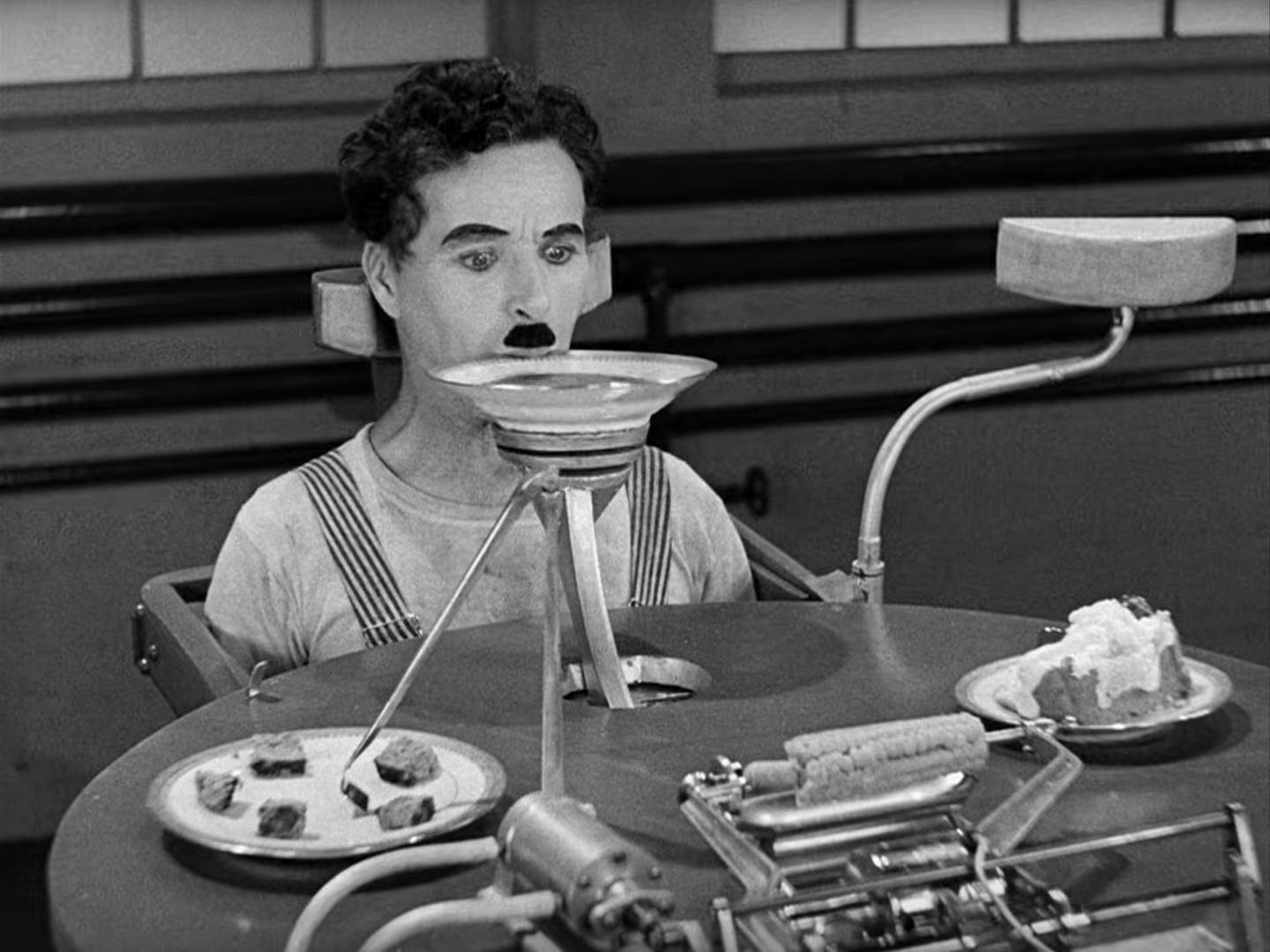
In a recent installment of his newsletter, our friend Max Read tries to arrive at a formal definition of “slop,” Merriam-Webster’s word of the year. He proposes this:
One idea I’ve been circling around is that “slop” is that which is “fully optimized” to its domain to the point of texturelessness or characterlessness. “Slop” in this sense is anything designed to be as easy as possible to produce, sell, and consume, but it’s particularly slop at the point where all or most other players in the same space adopt the same strategies, and the material is no longer individual or differentiated from its competitors.
This seems partially correct, but not entirely satisfying, for reasons Max himself points out: under his definition, things that are optimized for the better can still be called slop. And what does it mean, exactly, for something to be optimized? The cultural objects that win biggest in our attention economy — say, a Kendrick Lamar diss track or a softcore Canadian hockey romance — are clearly somehow optimal at earning mindshare by the simple fact of their success in doing so, but they’re not especially sloplike. If they’re calibrated for virality, it’s only as an incidental consequence of their quality or resonance. Still, some kind of optimization process must be happening somewhere if so much certifiable slop is filling people’s feeds.
Texturelessness, characterlessness, lack of differentiation, and ease of production and consumption all seem crucial to the concept of slop. At the heart of these properties is interchangeability: in any given domain, one unit of slop can substitute perfectly for another. Slop is fungible. When content becomes a commodity, each piece competes purely on how efficiently it can be created and distributed.
This is the real optimization going on: slop maximizes the ratio of attention gained to effort expended. It does the minimum work required to trigger engagement, and stops there. It scales infinitely, proliferating in the generative AI era as the cost of its production approaches zero.
What is it, though, that makes slop viable in the first place? Why did it take hold as a concept in the 2010s and 2020s instead of in earlier decades? It seems to make sense that slop emerges from the scrollable feed. The two words feel like they belong together, conjuring an image of users as pigs slurping from a trough. But what are the specific conditions of the feed that make it hospitable to slop?
“Switching cost” is a term in microeconomics for a consumer’s barrier to shifting from one product to another. A related idea is “search cost”: the time and effort required to evaluate an item and its alternatives. Usually, evaluating products is far easier than switching between them — it takes a lot less hassle and money to research cars or laptops or vacuum cleaners than it does to go buy a new one. In a typical social media app, this is reversed. The search cost, such that there is one, is the time it takes to evaluate the thing you’re looking at and decide if it’s worth your attention. This cost is small, but the switching cost is even smaller: you can just flick your thumb to scroll to another thing. To succeed, a post has to be compelling enough not to scroll away from. Slop is the stuff able to clear this bar at the minimum level. If you’re outputting content at scale, any investment beyond this is just wasted effort.
This is why a streaming service like Netflix produces a greater proportion of slop than a conventional movie studio. A theatrical film has a high switching cost — if you go see a movie and realize half an hour into it that it sucks, you’ve wasted your money. It’s worth it for the consumer to check the reviews before they choose a film so they can have a degree of confidence in its quality. By the relative inconvenience and expense of viewing them, theatrical releases have some incentive to be good. A streaming movie takes no effort to put on, and switching to a different one costs nothing. Instead of being good enough to get you to buy a ticket and leave the house, streaming content just has to be good enough to get you to keep watching. It’s not a coincidence that the medium most associated with sloplike qualities, before the advent of the internet, was network television. Slop emerges in environments where content is free for the consumer and eyeballs are the only valued metric.
Merriam-Webster’s definition of the word explicitly links it to AI-produced content. As Max makes clear in his piece, the term predates the current wave of generative tools. But the rapidly decreasing cost of spinning out low-effort junk is something new in the history of media. Slop may have gotten here first, but it was waiting for AI to bring it to full flower — the ultimate trade awaiting its ultimate practitioner, as Blood Meridian’s Judge Holden might say. Are we about to drown in the brown tide?
The hopeful case is that qualities like craftsmanship, uniqueness, and human expression will only matter more as slop comes to occupy the background noise of our media environment. Slop can bring attention and engagement, but by its undifferentiated nature, it can’t deliver a breakthrough cultural moment. It can fill the empty spaces in an online life characterized by a weird liminal state between boredom and real absorption. But even the most addicted scroller eventually needs to go look at, listen to, or do something that actually rewards their attention instead of merely holding it. If slop were more appealing, it might be more worrying. How dangerous is a drug that doesn’t even get you high?
As we’ve defined it here, slop is interchangeable content optimized to capture attention at minimal cost to the producer. Does slop have to be bad? Could it be good? If it making it better requires more resources, then its quality will stay at the lowest possible level. But what happens if the cost of production is effectively zero? Will AI enable quality slop that can genuinely compete with the kinds of cultural products we currently consider valuable?
In a hypothetical near future where automated processes can, for example, generate original films with prestige-level production values, or create songs as catchy and polished as human-written pop hits, it seems likely that our notions of prestige would shift. “Quality,” as we conceive of it today, might cease to function as a signal of value. If a thing can be mass-produced at no cost and with no effort, then it is, by definition, cheap. Value would have to migrate to the one thing no presently foreseeable AI can replicate: the individual lived experience of a conscious being.
The next few decades may end up being a test of what creative expression really means to our species. An inherent and often uncanny property of slop is that it seems to come from nowhere and conveys no particular point of view. At the other end of the spectrum sit the cultural works we value most. Whether produced by humans or machines, slop is generic and voiceless. The artists, athletes, and entertainers we continually celebrate are the ones who do things no one else can. The best definition of slop might be that which does the opposite.