

This article appears in the fall 2026 issue of The Toe Rag.
What exactly makes a story a story? What separates a plot from a mere sequence of events? In his Poetics, Aristotle identified the key ingredient as causality: the difference between post hoc and propter hoc. He held up Homer as the greatest practitioner of “unity of plot”, where events follow each other by necessity. He noted, though, that Homer’s Odyssey, when boiled down to its essential elements — absence, return, recognition, vengeance — was a fairly simple tale; “everything else is episodes.”
Causality is one of Christopher Nolan’s defining preoccupations. He’s made three separate films — Memento, Interstellar, and Tenet — that hinge on scrambling the normal order of cause and effect. The plot of The Dark Knight unfolds like an escalating turn-based game of moves and countermoves; the Joker himself is presented as an unintended effect of Batman’s existence, summoned into being by the hero’s rise. Oppenheimer isn’t about the construction of the atomic bomb so much as the reverberating consequences of that act. Many of Nolan’s narratives are chain reactions emanating from a single dramatic nucleus — a pivotal event to which we repeatedly loop back and don’t fully grasp until the finale. An intricate structure is assembled piece by piece, its components eventually locking into place to detonate an emotional payload made up of elements that were hidden in plain sight.
The complexity in Nolan’s work is engineered to be intelligible — this, more than anything else, is his signature. His stories are rule-based systems where time can bend and chronology is rarely linear, but the rules are always explicit. His visuals are tactile and functional, hardly ever representing anything more than what’s present in the frame. His dialogue exists mainly to impart information. Critics often describe his style as “literal”, and none of them mean it as a compliment. But the flip side of literalism is legibility. As structurally involved as his narratives may be, you don’t need to know anything to understand them. All of the required context comes included. You can be a person of almost any age, from practically anywhere in the world, and if you pay a modicum of attention, you will receive what the artist is trying to transmit. There are a number of reasons why Nolan’s films have such broad appeal, but this may be the decisive one. They’re one-size-fits-all, ready-to-wear.
It’s not much of a surprise, then, that Nolan would choose to tackle a text so embedded in Western culture that its shape is familiar even to those who’ve never heard of it. He’s said in interviews that the Odyssey is a story he’s been telling in all the films he’s made. To a degree, this is certainly true: homecoming, regret, war, and revenge all feature prominently in his work. But this ancient epic turns out to be a fascinatingly imperfect fit for his methods. In adapting Homer’s poem, Nolan applies his narrative instincts to a story that resists them, and his literalist style strands him in an awkward no-man’s-land between realism and myth.
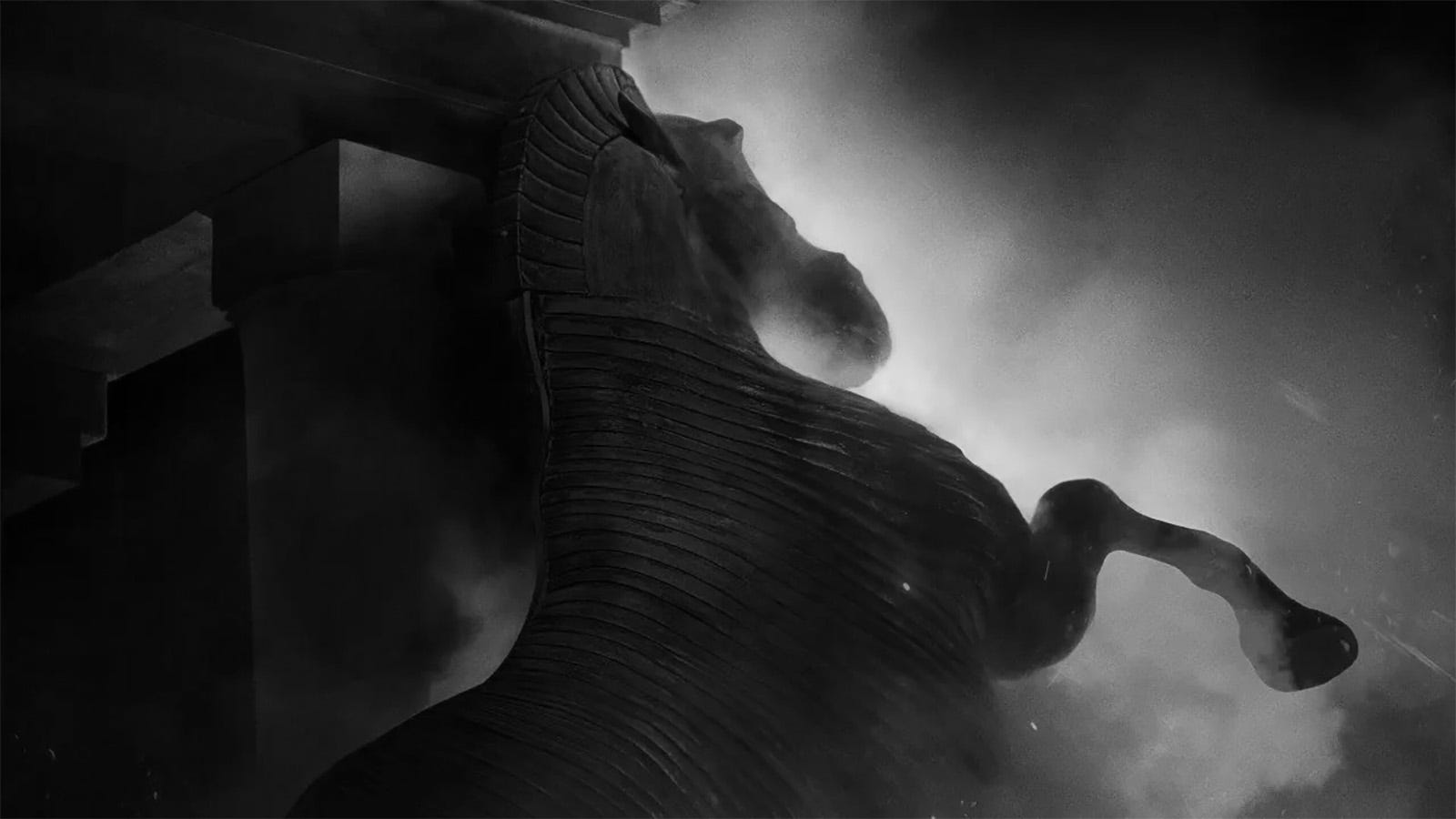
Nolan locates the nucleus of his Odyssey in the sack of Troy. The story of the Trojan Horse is treated as the hero’s crowning achievement before being revealed as a source of shattering guilt. This has been seen as a subversion of Homer, when in fact it’s one of the more faithful elements of Nolan’s adaptation. In the eighth book of the original epic, Odysseus asks the bard Demodocus to sing the song of the wooden horse. After hearing it, Odysseus bursts into tears. Per Emily Wilson’s translation: “His cheeks were wet with weeping, as a woman weeps, as she falls to wrap her arms around her husband, fallen fighting for his home and children. She is watching as he gasps and dies. […] Her face is marked with her despair. In that same desperate way, Odysseus was crying.” The hero is recited a tale of his own supposed triumph and he reacts like a helpless victim of precisely the kind of violence he and his men have committed. It’s the most surprising and audacious simile in Homer’s poem.
Nolan departs from the source not in revealing Odysseus’s guilt, but in building his narrative system around it. He positions the Trojan Horse as a violation of xenia, the ancient Greek concept of hospitality — which, in keeping with his commitment to accessibility, he refers to as “Zeus’s Law” — and he depicts this breach as the trigger of a chain reaction leading to the end of civilization. The totemic image to which the film keeps returning is the decapitation of a statue of Athena in the center of Troy. Odysseus has visions of a solemn and judgmental manifestation of Athena — the only Olympian to take human form in the movie. The dialogue frequently alludes to the ancient Greek belief that any stranger can be a god in disguise; Odysseus’s son Telemachus is constantly telling people they have “Athena’s eyes.”
Near the end of the film, Nolan pulls the pin on the grenade: the supposed goddess in Odysseus’s visions was a Trojan priestess of Athena, beheaded by his men while he stood by and watched, her eyes begging him for mercy. The desecration of Troy and its people has loosed a tide of barbarity that will soon drown Mycenaean culture — which, in Nolan’s fictional antiquity, is implied to be the epicenter of civilization instead of the regional power it really was. In this film, as in Oppenheimer and Tenet, a single act by a single man — a man driven by ego, alienated from love, and deluded about his ability to control events — threatens to bring about the end of the world.
Nolan tries hard to construct a narrative structure that serves this revelation. The strain is visible in the disjointed first half of the film as he piles up the building blocks of his edifice. Characters drop lore about Odysseus and explain Zeus’s Law to each other. The eventual payoff functions more or less as intended, and partly redeems the tedious labor of the early acts. But the empty chambers of Nolan’s architecture — the sections of the epic that Aristotle referred to as the hero’s “storm-tossed journey” — are filled with mere episodes. Here we see Nolan struggling with plot events that serve little purpose toward his overarching goal. There are filmmakers who relish narrative detours and the picaresque. Nolan, with his mathematical affinity for structural elegance, isn’t one of them. Like a watchmaker staring at leftover gears, he’s not sure what to do with the nonessential material.
In Homer’s version of the story, the encounter with Polyphemus is the most consequential of the hero’s adventures. It’s the blinding of the cyclops — Poseidon’s son — that ultimately dooms Odysseus’s journey home. The incident carries less meaning in Nolan’s framework. He dutifully exposes the creature’s parentage (by having a character say “That was the son of Poseidon”), but he mainly uses the sequence to present one of many violations of xenia by Odysseus and his crew. Though the rules of hospitality also play a central role in the original telling, Homer’s Polyphemus is a moral monstrosity, not just a physical one, who rejects the laws of the Olympian gods and mockingly inverts xenia by eating his guests instead of feeding them. This could make for an enjoyably twisted scene, but it doesn’t fit Nolan’s machinery. His Polyphemus is a gentle beast who’s simply unaware that the men he’s devouring are sentient beings. Odysseus and his crew demonstrate their moral rot by going into the giant’s cave and eating his cheese.
Most of the stops on Odysseus’s journey are similarly inert. An exception, at least briefly, is the visit to Circe’s island. The scene in which Odysseus’s men are molded into swine is a genuinely unsettling triumph of practical effects, and an all-too-rare instance of Nolan conveying meaning through images instead of words. His faith in our ability to grasp his intentions turns out to be fleeting: the sequence is immediately followed by Circe reciting the themes we’re meant to understand. And even with this blunt commentary in hand, Circe’s section of the story remains only tangential to the main thread.
Throughout the film, Nolan depicts Zeus and Poseidon as natural forces. He’s discussed his desire to situate the audience in the metaphysical frame of the ancient Greeks, who would have perceived lightning and storms as emanations from their gods. It’s a sensible aim, but Nolan is too committed to legibility for his tactile realism to feel anything but modern. By shrinking all possible distance between the audience and the setting — in language, manner, morality, and psychology — he grants his film immediacy while draining it of mystique. The fantastically detailed imagery of his IMAX cinematography transports us not to a mythical ancient world, but to the beautiful real-life locations where the movie was shot. Scenes where Matt Damon’s Odysseus passes time with Charlize Theron’s Calypso feel like nothing more than watching two very famous actors hang out on a beach. Whatever they may have cost artistically, Nolan’s decisions have paid off commercially: the film has grossed 1.75 billion dollars and counting.
“Our age of bronze is collapsing,” Odysseus informs Penelope in the film’s denouement. It’s a ridiculous line. By the logic of Nolan’s technique, it’s also a necessary one. To understand what the film as a whole is trying to communicate, you have to understand that the story is about a civilization that disintegrated and gave way to a less advanced culture. Some members of the audience will already know this. Many of them won’t. If a character simply says it out loud in a few words, everyone can get on the same level. The words could be less plain; the idea could be conveyed without words altogether. But that would risk some people not getting the point. To Nolan, this is an outcome far worse than embarrassment.